The short answer is that most vegan leather is plastic. Polyurethane or PVC, usually, bonded to a fabric backing. It looks like leather, it feels close enough to leather, no animal was involved, and that is where any resemblance to something organic ends.
Unless you have been under a rock for the last twenty years you have seen something sold as vegan leather, and if you are the curious type you have wondered what is in it. The word vegan does a lot of quiet work here. It suggests a raw salad of organic ingredients, wholesome and conveniently expensive, so the mind fills in plant-based and sustainable without being asked to. That is a marketing win rather than a material fact, and it is worth understanding before you put the term on your own hangtag.
What Is Vegan Leather Made From?
Two materials account for the overwhelming majority of what gets sold as vegan leather. Polyurethane (PU) is the softer and more expensive of the two, and it drapes and creases in a way that reads as leather. PVC is cheaper, stiffer, and more durable in the short term, and it is what most inexpensive bags and shoes are made from. Both are petroleum products.
The plant-based alternatives are real, and they are a much smaller slice of the market than the coverage suggests. Here is the honest version of the shelf.
| Material | What It Is | Performance | Small-Volume Availability |
|---|---|---|---|
| PU (polyurethane) | Petroleum-based polymer on a woven or knit backing | Good hand and drape, tends to crack or delaminate after a few years | Easy, wide colour range |
| PVC | Petroleum-based polymer with plasticisers | Tough and wipeable, stiffens in cold, poor breathability | Easy and cheap |
| Piñatex | Pineapple leaf fiber felt with a resin finish | Distinctive texture, less uniform than PU, moderate abrasion resistance | Limited, and minimums are real |
| Cork | Cork shavings laminated to fabric | Light, water resistant, unmistakable look | Reasonable |
| Apple, grape, or cactus leather | Fruit or plant waste blended with PU binder, often a minority of the total content | Varies enormously by supplier | Limited, and check the bio content percentage |
| Mycelium (mushroom) | Grown fungal material, finished with a coating | Closest to real leather in hand, still scaling up | Difficult at small volume |
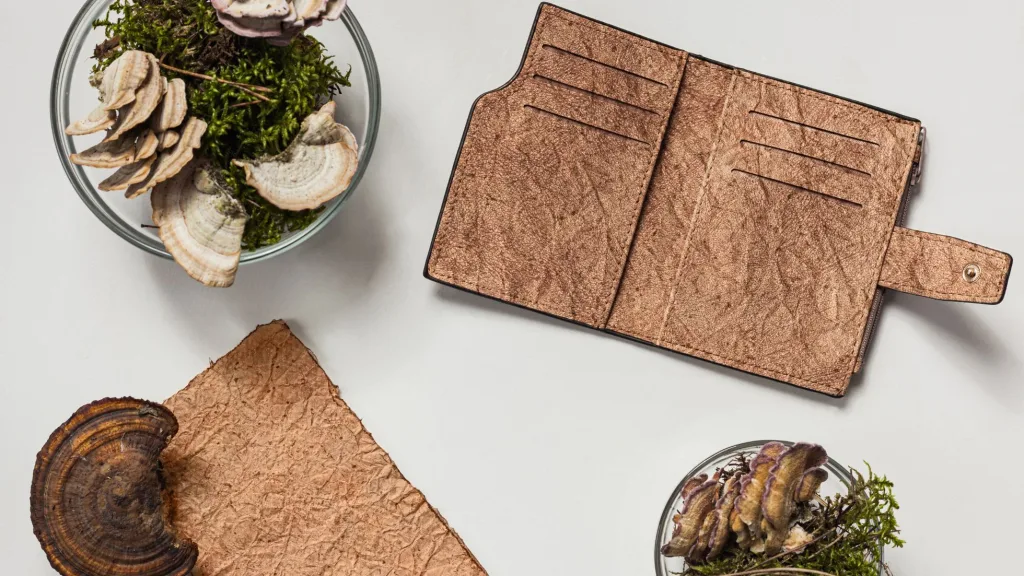
That fourth row is the one to watch. A material marketed as apple leather may be a modest percentage of apple waste held together with polyurethane, and the supplier is under no obligation to lead with that number. Ask for it in writing. A brand that repeats a supplier’s claim without checking it is the one that ends up answering for it.
Is Vegan Leather Better For The Environment?
It depends entirely on which one you buy and how long the product lasts, and anyone who gives you a cleaner answer than that is selling something.
The case for it is straightforward. No animal is raised or killed. There is no chrome tanning, which is one of the more damaging processes in the leather supply chain. Some products use recycled polyester or recycled PU backings, and cork and pineapple versions genuinely divert agricultural waste.
The case against is equally straightforward. PU and PVC come from fossil feedstock and do not biodegrade. PVC production and disposal involve chemistry that most sustainability frameworks treat as a red flag. And the durability gap matters more than most comparisons admit: a well-made leather bag can last decades, while a PU bag often starts flaking within five years. A product replaced four times is not the low-impact option, whatever it was made from.
How Does It Behave In Production?
The thing most designers learn late is that the backing fabric decides the product. The coating gives you the look, and the woven or knit substrate underneath gives you the strength, the stretch, and the way the material behaves at a stitch line. Two rolls with identical faces can perform completely differently because one is backed with a decent twill and the other with a thin knit.
Practically, coated materials do not forgive. A needle hole is permanent, so unpicking a seam leaves a visible line and rework is rarely an option. Edges need finishing or they delaminate. Pressing is limited by the coating’s heat tolerance, which is usually far lower than the fabrics your factory presses all day. None of this is difficult, but it does need to be specified rather than assumed, and it is worth confirming that your factory has run the material before rather than discovering the learning curve in your production run.
What Are You Allowed To Call It?
This is the part that catches brands out, and it has nothing to do with the material itself. Several markets restrict the use of the word leather for anything that did not come off an animal, and the rules differ from one country to the next. Terms like faux leather, synthetic leather, or coated fabric sit on safer ground than leather with an adjective in front of it, and a spec-accurate description on the care label costs you nothing.
The same caution applies to the sustainability language. Describing a PU material as eco-friendly because no animal was involved is the kind of claim that regulators in several markets have started taking an interest in, and a competitor or a customer only has to read the composition to challenge it. Say what it is made from and let the reader draw the conclusion. We are not lawyers, so check the specific rules for the markets you sell into before the labels get printed.
How Long Will It Last?
Less time than your customer expects, which is worth managing up front. PU typically starts to crack or peel somewhere between two and five years depending on how much flexing and sunlight it gets, and heat is what accelerates it. PVC lasts longer against abrasion but goes brittle in cold and stiffens with age. Plant-based versions with a PU topcoat fail the same way the topcoat does.
Care instructions help more than most brands assume. Wipe with a damp cloth rather than washing, keep it out of direct sun and away from radiators, and avoid conditioners made for real leather since they do nothing for a polymer coating. A customer who gets four good years out of a bag tells a different story than one who gets eighteen months.
What Should You Ask A Supplier?
Ask what the coating is, PU or PVC, because plenty of suppliers will say vegan leather and hope the question stops there. Ask what the backing fabric is and what it weighs. Ask for the bio-based content as a percentage if the material is sold on a plant story, and ask for the certificate that supports it. Ask what the minimum is per colour rather than per order. And ask for a sample large enough to sew, because the difference between materials shows up at the seam rather than in a swatch.
If you are weighing this against other options, our guides to Piñatex and bamboo fabric cover the same ground of a sustainability claim that needs checking before you repeat it, and it helps to know where these materials are made.
Vegan leather is a legitimate material with a misleading name. Use it where the look and the price work for your product, be specific in your marketing about what it is made from, and pick the version that will outlive the season. The brands that get into trouble with it are not the ones that used plastic. They are the ones that called it something else. Our development team can source and test these materials with you before you commit a range to one.